Do You Think We Can Be "Fully Human" While Interacting With Others in a Virtual Space?
5.three Social Interaction in Everyday Life
Learning Objectives
- Describe what is meant by dramaturgy and by impression management.
- Provide one example of role disharmonize or role strain.
- List one or two gender differences in nonverbal communication.
A fundamental feature of social life is social interaction, or the ways in which people act with other people and react to how other people are acting. To recall our earlier paraphrase of John Donne, no 1 is an island. This ways that all individuals, except those who choose to alive truly alone, collaborate with other individuals almost every twenty-four hour period and often many times in any ane day. For social society, a prerequisite for whatever society, to exist possible, constructive social interaction must be possible. Partly for this reason, sociologists interested in microsociology have long tried to understand social life past analyzing how and why people interact they way they do. This department draws on their work to examine various social influences on private behavior. As you read this section, you volition probably be reading many things relevant to your own social interaction.
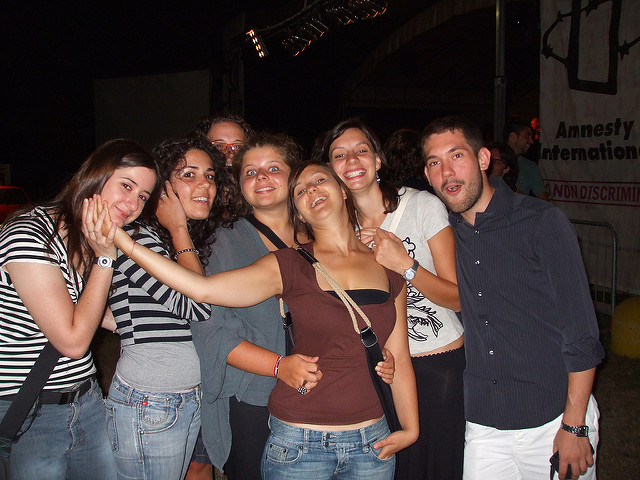
Social interaction is a primal feature of social life. For social lodge to be possible, effective social interaction must besides be possible.
Martina – Friends – CC Past-NC-ND ii.0.
Chapter iv "Socialization" emphasized that socialization results from our social interaction. The reverse is as well truthful: we learn how to interact from our socialization. We have seen many examples of this process in earlier chapters. Among other things, nosotros learn from our socialization how far apart to stand when talking to someone else, we larn to enjoy kissing, we learn how to stand and behave in an elevator, and we larn how to acquit when we are drunk. Perhaps most important for the present discussion, we particularly learn our society'south roles, outlined before as a component of social construction. The importance of roles for social interaction merits farther discussion hither.
Roles and Social Interaction
Our earlier discussion of roles divers them every bit the behaviors expected of people in a certain status. Regardless of our individual differences, if nosotros are in a certain status, we are all expected to bear in a way appropriate to that status. Roles thus assistance make social interaction possible.
As our example of shoppers and cashiers was meant to suggest, social interaction based on roles is usually very automatic, and we oftentimes perform our roles without thinking about them. This, in fact, is why social interaction is indeed possible: if nosotros always had to call up near our roles earlier we performed them, social interaction would be boring, tiresome, and fraught with error. (Analogously, if actors in a play always had to read the script before performing their lines, as an understudy sometimes does, the play would be dull and stilted.) It is when people violate their roles that the importance of roles is thrown into sharp relief. Suppose you were shopping in a section store, and while you were in the checkout line the cashier asked you how your sex life has been! Now, you lot might expect such an intimate question from a very close friend, considering discussions of intimate matters are office of the roles shut friends play, but y'all would definitely non expect it from a cashier you do not know.
As this case suggests, effective social interaction rests on shared groundwork assumptions, or our understanding of the roles expected of people in a given meet, that are easily violated if one has the nerve to do and so. If they are violated, social society might well intermission down, as you would quickly find if you dared to inquire your cashier how her or his sexual activity life has been, or if ii students sitting in class violated their student role by kissing each other passionately. Sociologist Harold Garfinkel (1967) argued that unexpected events like these underscore how fragile social guild is and remind us that people are constantly constructing the social reality of the situations in which they detect themselves. To illustrate his point, he had his students perform a series of experiments, including acting like a stranger in their parents' home. Non surprisingly, their parents quickly became flustered and wondered what college was doing to their daughters and sons!
These examples indicate that social reality is to a large extent socially constructed. Information technology is what we make of information technology, and individuals who interact assist construct the reality of the state of affairs in which they interact. Sociologists refer to this process equally the social construction of reality (Berger & Luckmann, 1963). Although we usually come into a state of affairs with shared understandings of what is nearly to happen, as the interaction proceeds the actors proceed to define the situation and thus to construct its reality. This view lies at the eye of the symbolic interactionist perspective and helps the states empathise how and why roles (or to be more precise, our agreement of what beliefs is expected of someone in a sure status) brand social interaction possible.
Roles and Personalities
Roles help us interact and assist brand social order possible, but they may even shape our personalities. The idea hither is that if nosotros presume a new role, the expectations of that role tin change how nosotros interact with others and even the way we think most ourselves. In curt, roles tin change our personalities.
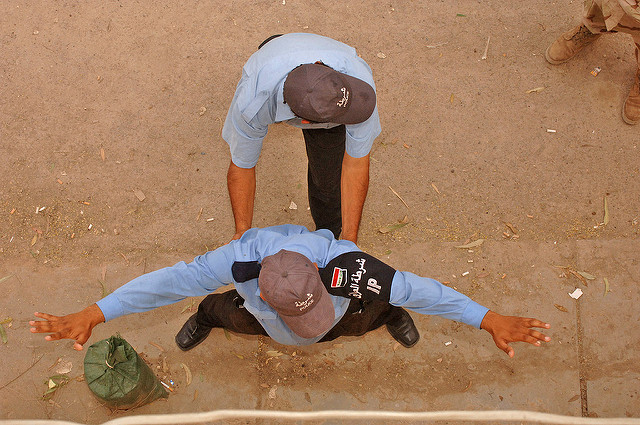
Roles can shape personalities. When individuals become constabulary officers, the nature of their job can prompt them to act and think in a more than authoritarian mode.
A telling instance of this outcome comes from the story of a criminal justice professor from Florida named George Kirkham. In his classes, Kirkham would be disquisitional of the harshness with which police treated suspects and other citizens. 1 day, some police officers in one of his classes said Kirkham could non begin to understand what information technology was similar beingness a police force officer, and they challenged him to get one. He took upwards the challenge by gaining admission to a police force academy and going through the regular training program for all recruits. Kirkham (1984) later recounted what happened on his showtime few days on the job. In one episode, he and his veteran partner went into a bar where an intoxicated patron had been causing problem. Kirkham politely asked the patron to go with him outside. Evidently surprised past this new police officer's politeness, the human being instead swung at Kirkham and landed a blow. Kirkham could not believe this happened and was forced to subdue his assailant. In another episode, Kirkham and his partner were checking out the driver of a double-parked car. An ugly crowd soon gathered and began making threats. Alarmed, Kirkham opened upwards his auto's trunk and pulled out a shotgun to keep the crowd abroad. In recounting this episode, Kirkham wrote that as a professor he quickly would have condemned the police officer he had now become. In a few short days, he had turned from a polite, kind professor into a gruff, angry law officeholder. His part had inverse and, forth with information technology, his personality.
Role Problems
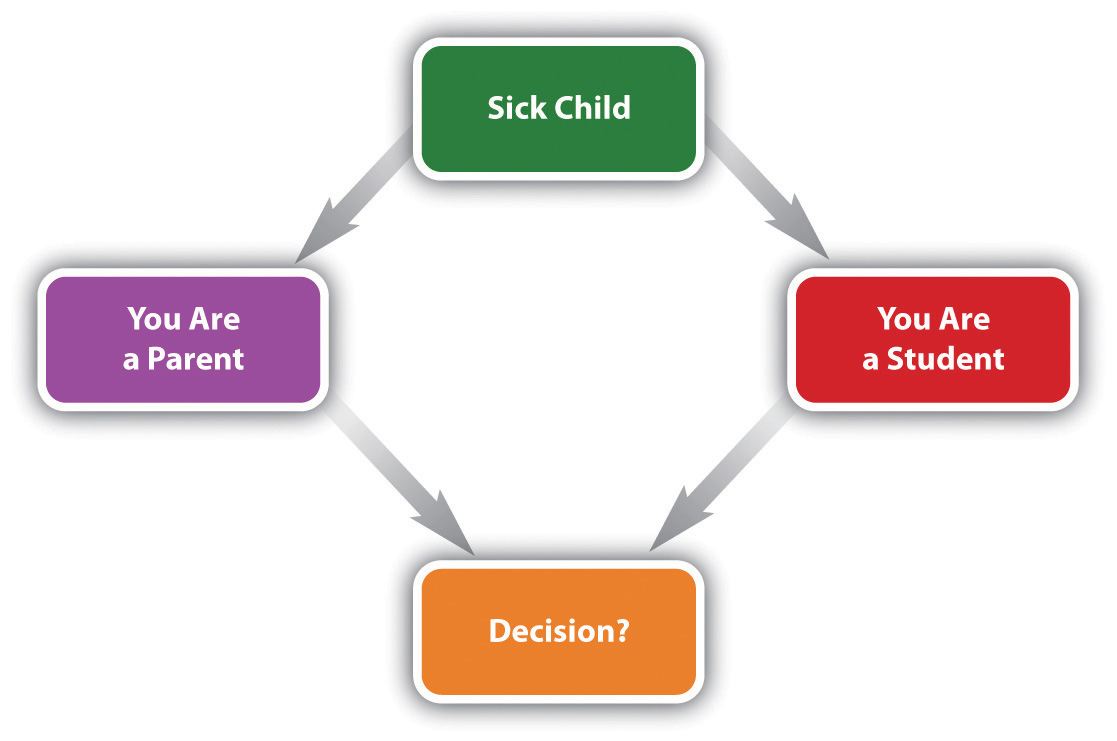
Roles help our interactions run smoothly and automatically and, for better or worse, shape our personalities. Simply roles tin can also crusade various kinds of problems. One such trouble is role conflict, which occurs when the roles of our many statuses conflict with each other. For case, say you are a educatee and also a parent. Your 3-twelvemonth-old kid gets sick. You lot at present accept a conflict betwixt your role equally a parent and your role as a student. To perform your role as a parent, you lot should stay home with your sick kid. To perform your part equally a student, y'all should go to your classes and have the large exam that had been scheduled weeks ago. What do y'all do?
Figure 5.3 Example of a Role Conflict
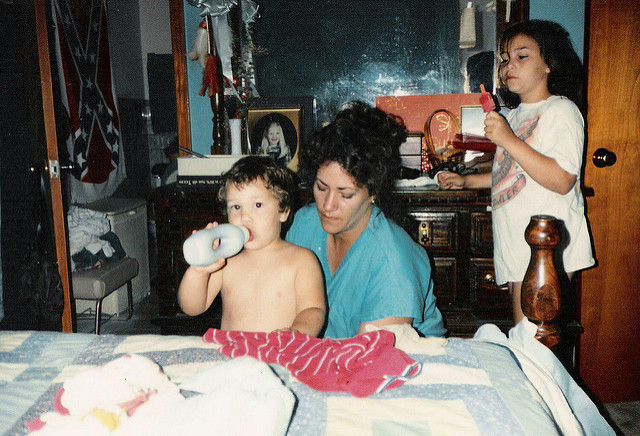
Parents tin often experience role conflict stemming from the fact that they have both parental responsibilities and work responsibilities.
I thing is clear: you lot cannot perform both roles at the same time. To resolve role conflict, we ordinarily take to choose between 1 part and the other, which is often a hard choice to make. In this example, if you take care of your child, y'all miss your classes and exam; if you lot get to your classes, you have to exit your child at home lone, an unacceptable and illegal selection. Another way to resolve function conflict is to observe some alternative that would meet the needs of your conflicting roles. In our sick child instance, you might be able to find someone to watch your child until yous tin go back from classes. It is certainly desirable to discover such alternatives, but, unfortunately, they are not always forthcoming. If role conflict becomes too frequent and astringent, a final pick is to leave one of your statuses altogether. In our case, if you observe information technology as well difficult to juggle your roles every bit parent and student, you could stop beingness a parent—hardly likely!—or, more probable, accept time off from school until your child is older. Most of us in these circumstances would try our best to avoid having to practise this.
Another role-related trouble is called role strain. Here yous have one condition, and a role associated with it, that is causing issues because of all the demands coming to you from people in other statuses with which your ain condition is involved. Suppose yous were a loftier school principal. In your one part as a principal, you come into contact with people in several dissimilar statuses: teachers, students, custodial and back up staff, the superintendent, school board members, the community as a whole, and the news media. These statuses may make competing demands on you in your ane part as a principal. If your high school has a apparel lawmaking, for instance, the students may want you lot to abolish information technology, the teachers and superintendent may want yous to go along information technology, and peradventure the schoolhouse lath would agree with the students. Every bit you try to please all these competing factions, you certainly might experience some office strain!
A third blazon of role problem occurs when we occupy a status whose role demands a certain blazon of personality that differs from the i we actually have. Can yous imagine a constabulary officeholder who was afraid of guns? An athlete who was not competitive? A flight bellboy who did not like helping people or was afraid of flying? Although almost people avoid this type of part trouble by not taking on a function to which their personality is sick suited, such problems occur nonetheless. For instance, some people who dislike children and do not have the patience to exist good parents stop upwardly being parents anyway. In some other case, your author once knew a new professor who was woefully nervous lecturing in front of students. Y'all might wonder why he became a professor in the first place, only he probably just loved the subject matter then much that he thought he would overcome his nervousness. He did not.
Dramaturgy and Impression Management
From a sociological standpoint, much of our social interaction tin can be understood past likening it to a performance in a play. As with so many things, Shakespeare said it best when he wrote,
All the world'south a stage,
And all the men and women merely players.
They have their exits and their entrances;
And i human in his time plays many parts. (As Yous Like It, Act II, Scene 7)
From this perspective, each private has many parts or roles to play in society, and many of these roles specify how we should collaborate in any given state of affairs. These roles exist before we are born, and they go along long after we die. The civilisation of society is thus similar to the script of a play. Only as actors in a play learn what lines to say, where to stand on the stage, how to position their bodies, and then many other things, so do we learn equally members of society the roles that specify how we should interact.
This key metaphor was developed and popularized by sociologist Erving Goffman (1959) in what he called a dramaturgical arroyo. Past this he meant that we can understand social interaction as if it were a theatrical performance. People who collaborate are actors on a stage, the things they say and do are equivalent to the parts actors play, and whatever people who observe their interaction are equivalent to the audience at a play. As sociologists Jonathan H. Turner and Jan E. Stets (2006, p. 26) summarize this arroyo, "Individuals are, in essence, dramatic actors on a stage playing parts dictated by culture, and, similar all theater, they are given some dramatic license in how they play roles, every bit long as they do non deviate too far from the emotional script provided by culture."
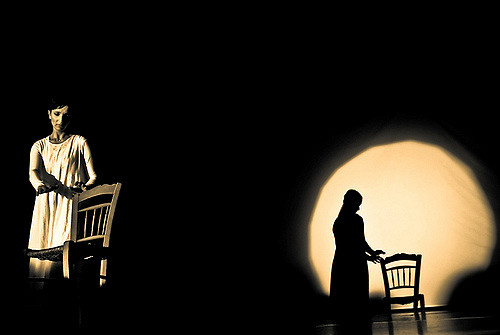
Erving Goffman's dramaturgical arroyo likened social interaction to acting in a theatrical performance.
Beyond these aspects of his theatrical illustration, Goffman also stressed that the presentation of self guides social interaction merely as it guides behavior in a play. Actors in a play, he wrote, aim to act properly, which at a minimum ways they need to say their lines correctly and in other means deport out their parts as they were written. They endeavour to convey the impression of their grapheme the playwright had in listen when the play was written and the director has in heed when the play is presented.
Such impression management, Goffman wrote, also guides social interaction in everyday life. When people interact, they routinely endeavour to convey a positive impression of themselves to the people with whom they interact. Our behavior in a job interview differs dramatically (pun intended) from our behavior at a party. The primal dimension of social interaction, and so, involves trying to manage the impressions we convey to the people with whom we interact. Nosotros commonly exercise our all-time, consciously or unconsciously, to manage the impressions nosotros convey to others and then to evoke from them reactions that will please u.s..
Goffman wrote nearly other aspects of social interaction that touch on our efforts to manage these impressions. Once again using his dramaturgical metaphor, he said that some interaction occurs in the "frontstage," or front region, while other interaction occurs in the "backstage," or back region (Goffman, 1959, p. 128). In a play, of course, the frontstage is what the audition sees and is plain the location in which the actors are performing their lines. Backstage, they can practise whatever they desire, and the audience will have no idea of what they are doing (every bit long as they are serenity). Much of our everyday interaction is on the frontstage, where an audience can come across everything we do and hear everything we say. But we also spend a lot of fourth dimension on the backstage, past ourselves, when we can practice and say things in individual (such equally singing in the shower) that we would not cartel do or say in public.
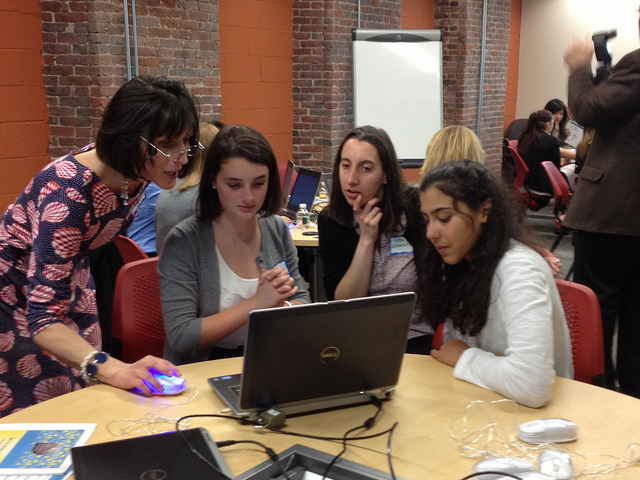
Social interaction involves impression management. How a pupil behaves with a professor is probably very different from how the same student behaves when out on the boondocks with friends.
How we dress is too a course of impression management. You are the same person regardless of what apparel you wear, but if you dress for a job interview as you would dress for a party (to use our earlier instance), the person interviewing yous would get an impression yous might not want to convey. If yous showed up for a medical visit and your doc were wearing a bathing accommodate, wouldn't you lot feel just a bit uneasy?
Sociology Making a Difference
Impression Management and Job Interviewing
Erving Goffman's (1959) concept of impression management, discussed in the text, is one of the central sociological insights for the understanding of social interaction. One reason the concept has been so useful, and one reason that it interests many college students, is that impression management has so much applied relevance. Anyone who has gone out on a first date or had a job interview can immediately recognize that impression direction is something nosotros all practise and can immediately realize the importance of effective impression management.
Impression direction is important in many settings and situations only maybe peculiarly important in the job interview. Many scholarly publications and chore-hunting manuals emphasize the importance of proper impression management during a chore interview, particularly an interview for a full-time, well-paying job, as opposed to a fast-food job or something similar (Van Iddekinge, McFarland, & Raymark, 2007). The strategies they discuss include impression management involving apparel, body language, and other dimensions of social interaction. Interviewing tips they recommend include (a) dressing professionally, (b) showing up early for the interview, (c) shaking hands firmly while smiling and looking the interviewer in the heart, (d) sitting with a comfortable but erect posture without crossing i'due south artillery, (e) maintaining centre contact with the interviewer throughout the interview, and (f) shaking hands at the terminate of the interview and saying thank you.
These strategies and tips are probably more than familiar to college students from wealthy backgrounds than to working-course people who accept not gone to college. Sociologists emphasize the importance of cultural uppercase, or attitudes, skills, and noesis that enable people to achieve a college social status (Bourdieu & Passeron, 1990). People who grow up in poverty or virtually-poverty, including disproportionate numbers of people of colour, are less likely than those who grow up in much wealthier circumstances to possess cultural capital. The attitudes, skills, and knowledge that many higher students have and have for granted, including how to conduct oneself during a chore interview, are much less familiar to individuals who grow up without cultural capital. To use some sociological language, they know much less about how to manage their impressions during a job interview should they get one and thus are less probable to exist hired subsequently an interview.
For this reason, many public and individual agencies in poor and working-form communities effectually the land regularly hold workshops on job interviewing skills. These workshops emphasize strategies like to those outlined earlier. One of the many organizations that offering these workshops and provides related services is the Los Angeles Urban League (http://www.laul.org/milken-family-literacy-and-youth-training-center) through its Milken Family Literacy and Youth Training Center. According to its Web site, this center "provides a comprehensive organisation of services of programs and services to assist youth and adults in developing the skills to compete for and obtain meaningful employment." Much of what the youth and adults who nourish its workshops and other programs are learning is impression-management skills that help them find employment. Goffman's concept is helping make a divergence.
Individuals appoint in impression management, but then do groups and organizations. Consider the medical visit just mentioned. A md'southward office usually "looks" a certain style. It is clean, it has rug, it has attractive furniture, and it has magazines such every bit People, Time, and Sports Illustrated. Such an office assures patients past carrying the impression that the md and staff are competent professionals. Imagine that you entered a physician's office and saw torn carpet, some broken furniture, and magazines such as Maxim and Playboy. What would be your instant reaction? How soon would you plough around and leave the office? As this fanciful example illustrates, impression management is critically of import for groups and organizations equally well equally for individuals.

Impression direction occurs with physical settings. These ii eating establishments convey very dissimilar impressions of the quality of nutrient and service that diners can look.
Life is filled with impression management. Compare the decor of your favorite fast-food restaurant with that of a very expensive restaurant with which y'all might be familiar. Compare the advent, clothes, and demeanor of the servers and other personnel in the 2 establishments. The expensive restaurant is trying to convey an image that the food will be wonderful and that the fourth dimension y'all spend there will be memorable and well worth the money. The fast-food restaurant is trying to convey just the opposite impression. In fact, if it looked too fancy, you would probably remember it was too expensive.
Some people go to great efforts to manage the impressions they convey. Y'all take probably done so in a task interview or on a engagement. In New York City, the capital of book publishing, editors of large publishing companies and "superagents" for authors are very conscious of the impressions they convey, because much of the publishing manufacture depends on gossip, impressions, and the evolution of rapport. Editors and agents oftentimes dine together in one of a few very expensive "ability" restaurants, where their presence is sure to be noted. Publishers or senior editors who dine at these restaurants will swallow only with celebrity authors, other senior editors or publishers, or important agents. Such agents rarely dine with junior editors, who are only "allowed" to consume with junior agents. To eat with someone "beneath" your standing would convey the wrong impression (Arnold, 1998).
Emotions and Social Interaction
When nosotros interact with others, certain emotions—feelings that begin with a stimulus and that often involve psychological changes and a desire to appoint in specific actions—oft come into play. To understand social interaction, it is helpful to understand how these emotions emerge and how they affect and are afflicted past social interaction.
Not surprisingly, evolutionary biologists and sociologists differ in their views on the origins of emotions. Many evolutionary biologists think that man emotions exist today because they conferred an evolutionary reward when homo civilization began eons ago (Plutchik, 2001). In this manner of thinking, an emotion such equally fear would help prehistoric humans (as well as other primates and organisms) survive past enabling them to recognize and avoid dangerous situations. Humans who could feel and act on fear were thus more likely to survive than those who could non. In this way, fear became a biological instinct and part of our genetic heritage. The fact that emotions such every bit anger, fear, hate, joy, love, and sadness are found across the world and in every culture suggests that emotions are indeed part of our biological makeup equally humans.
In contrast to the evolutionary approach, a sociological approach emphasizes that emotions are socially constructed (Turner & Stets, 2006). To remember our before discussion of the social construction of reality, this means that people learn from their culture and from their social interactions which emotions are appropriate to display in which situations. In detail, statuses and the roles associated with them involve expectations of specific emotions that are appropriate or inappropriate for a given status in a given social setting. Someone attending a wedding is expected to look and be happy for the couple almost to exist married. Someone attending a funeral is expected to look and be mournful. Emotions are socially constructed because they arise out of the roles nosotros play and the situations in which we find ourselves.
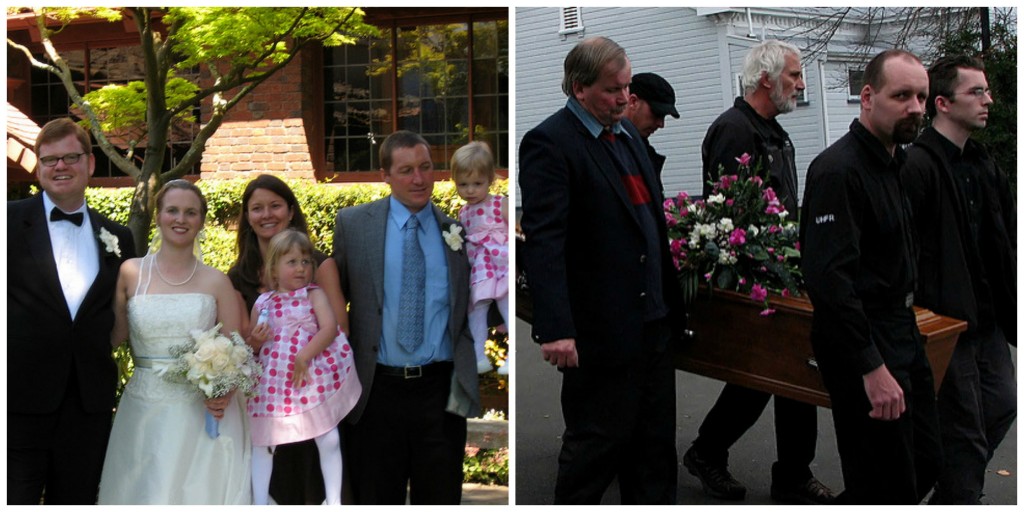
Sociologists emphasize that emotions are socially synthetic, as they arise out of expectations for specific roles in specific settings. Because nosotros wait people to have very different emotions at weddings and funerals, they usually finish up having these emotions.
Elliot Harmon – Hymeneals – CC BY-SA 2.0; spazbot29 – Funeral – CC BY-SA ii.0.
The origins of emotions aside, emotions notwithstanding play an essential role in social interaction, and social interaction gives rise to emotions. Accordingly, sociologists accept discussed many aspects of emotions and social interaction (Turner & Stets, 2006), a few of which nosotros outline hither. I important aspect is that insincere displays of emotion tin can exist used to manipulate a situation. For example, a child or adult may cry to win some sympathy, a brandish popularly called "crocodile tears." A staple of many novels and films is to pretend to be deplorable that a rich, elderly relative is very ill in order to win a place in the relative's will. By the aforementioned token, though, people who display inappropriate emotions gamble social disapproval. If you lot are attending a funeral of someone you did not really know that well and, out of boredom, recollect of a recent episode of The Simpsons that makes yous chuckle, the glares you get volition brand it very clear that your emotional display is quite inappropriate.
Every bit this instance suggests, a second aspect of emotions is that we often discover ourselves in situations that "demand" certain emotions we simply do not feel. This discrepancy forces most of us to manage our emotions to avert social disapproval, a process called emotion work (Hochschild, 1983). Having to engage in emotion work in turn often leads us to feel other emotions such as anger or frustration.
A tertiary attribute is that gender influences the emotions we feel and brandish. In folklore, work on gender and emotions oftentimes falls under the larger topic of femininity and masculinity as expressions of gender roles, which Chapter 11 "Gender and Gender Inequality" examines at greater length. Suffice information technology to say here, though at the risk of sounding stereotypical, that certain gender differences in emotions and the display of emotions practise be. For example, women cry more often and more intensely than men, and men outwardly express anger much more ofttimes than women. A fundamental question is whether gender differences in emotions (also every bit other gender differences) stem more from biological science or more than from civilization, socialization, and other social origins. Chapter 11 "Gender and Gender Inequality" over again has more than to stay well-nigh this basic debate in the study of gender.

According to sociologist Jonathan Turner, positive emotions are found more than often among the wealthy, while negative emotions are constitute more oftentimes among the poor.
A final attribute is that emotions differ across the social classes. Jonathan Turner (2010) notes that some emotions, such as happiness and trust, are positive emotions, while other emotions, such every bit acrimony, fear, and sadness, are negative emotions. Positive emotions, he says, pb to more successful social interaction and aid proceeds needed resources (e.g., a cheerful demeanor and self-conviction can help win a high-paying job or attract a romantic partner), while negative emotions take the opposite effect. He adds that positive emotions are more frequently found among the upper social classes, while negative emotions are more than often found among the poorer social classes. Emotion is thus "a valued resources that is distributed unequally" (Turner, 2010, pp. 189–190). The upper classes do good from their positive emotions, while the lower classes endure various problems considering of their negative emotions. In this manner, the social class difference in positive versus negative emotions helps reinforce social inequality.
Nonverbal Social Interaction
Social interaction is both exact and nonverbal. Equally Affiliate iii "Culture" discussed, culture greatly influences nonverbal communication, or ways of communicating that practise non involve talking. Nonverbal advice includes the gestures we use and how far apart nosotros stand when we talk with someone. When we do talk with someone, much more than nonverbal interaction happens beyond gestures and standing apart. We might smile, express mirth, frown, grimace, or engage in any number of other facial expressions (with or without realizing nosotros are doing so) that let the people with whom we interact know how we feel almost what nosotros are proverb or they are saying. Often how we act nonverbally is at to the lowest degree as important, and sometimes more important, than what our mouths are proverb.
Trunk posture is another course of nonverbal communication, and one that often combines with facial expressions to convey how a person feels. People who are angry may cross their arms or stand with their hands on their hips and glare at someone. Someone sitting slouched in a chair looks either very comfortable or very bored, and neither posture is i you would want to use at an interview for a job you really wanted to go. Men and women may appoint in sure postures while they are flirting with someone. Consciously or not, they sit or stand in certain ways that convey they are romantically interested in a particular person and hopeful that the person will return this involvement.
Learning From Other Societies
Personal Space and Standing Apart: Why People From Other Countries Think Americans Are Common cold and Distant
Every bit the text discusses, one aspect of nonverbal interaction involves how far we stand autonomously from someone with whom we are talking. To amplify on a betoken first mentioned in Affiliate 2 "Center on Order: Doing Sociological Research", Americans and the citizens of Smashing Britain and the northern European nations customarily stand up about three to 4 feet apart from someone who is a stranger or associate. If nosotros are closer to this person without having to be closer—that is, we're not in a crowded lift, bar, or other setting in which it is impossible to be further apart—nosotros feel uncomfortable.
In dissimilarity, people in many parts of the world—South and Cardinal America, Africa, the Middle East, and Western European nations such as French republic, Kingdom of spain, and Italy—stand up much closer to someone with whom they are talking. In these nations, people stand only about ix to 15 inches apart when they talk. If someone for some reason wanted to stand another two anxiety away, a member of one of these nations would view this person as unfriendly and might well feel insulted (Ting-Toomey, 1999; Samovar, Porter, & McDaniel, 2010).
Your author once found himself in this situation in Maine. I was talking to a professor from a Centre Eastern nation who was standing very close to me. To feel more comfy, I moved back a step or two, without actually realizing information technology. The professor moved forwards, evidently to feel more than comfy himself, so I moved dorsum. He again moved forward, and I over again moved back. Within a few minutes, nosotros had moved about 20 to 30 feet!
When Americans travel abroad, anecdotal show indicates that they often think that people in other nations are pushy and demanding and that these citizens view Americans as common cold and aloof (Ellsworth, 2005). Although there are many cultural differences between Americans and people in other lands, personal space is 1 of the most important differences. This fact yields an important lesson for whatever American who travels abroad, and it also illustrates the significance of civilisation for behavior and thus the value of the sociological perspective.
As with emotions, gender appears to influence how people communicate nonverbally (Hall, 2006). For example, a number of studies find that women are more likely than men to grin, to nod, and to have more expressive faces. Once once more, biologists and social scientists disagree over the origins of these and other gender differences in nonverbal communication, with social scientists attributing the differences to gender roles, culture, and socialization.
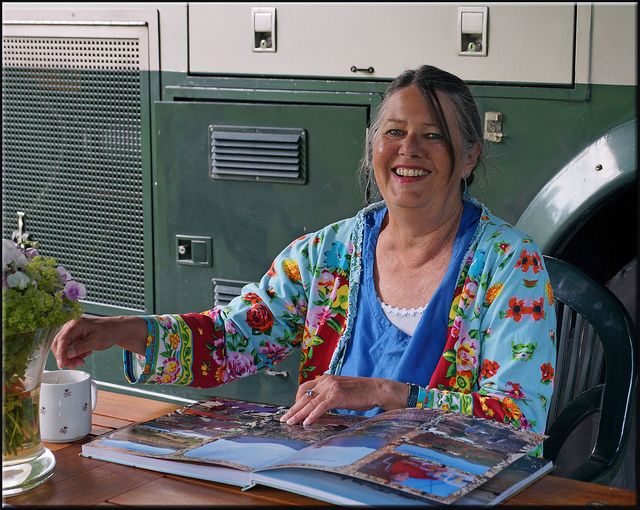
Enquiry finds that women tend to smile more often than men. Biologists and social scientists disagree over the origins of this gender difference in nonverbal communication.
Gender differences as well be in two other forms of nonverbal interaction: eye contact and touching. Women tend more than than men to await directly into the eyes of people with whom they interact, a procedure called gazing. Such gazing is meant to convey interest in the interaction and to be nonthreatening. On the other mitt, men are more likely than women to stare at someone in a way that is indeed threatening. A man might stare at a man because he resents something the other homo said or did; a man might stare at a woman because he optics her as a sexual object. In touching, men are more likely than women to touch someone, peculiarly when that someone is a woman; as he guides her through a doorway, for example, he might put his arm behind her arm or back. On the other hand, women are more likely than men to bear upon themselves when they are talking with someone, a process chosen self-touching. Thus if a woman is proverb "I call back that…," she might briefly touch the area just below her neck to refer to herself. Men are less likely to refer to themselves in this fashion.
Key Takeaways
- A dramaturgical approach likens social interaction to a dramatic production.
- Individuals usually attempt to manage the impression they make when interacting with others. Social interaction can exist understood as a series of attempts at impression management.
- Various kinds of role strains and problems ofttimes occur every bit individuals endeavor to perform the roles expected of them from the many statuses they occupy.
- Emotions and nonverbal communication are essential components of social interaction. Sociologists and biologists disagree on the origins of gender differences in these ii components.
For Your Review
- Describe a recent example of how you tried to manage the impression you were conveying in a social interaction.
- Describe a recent example of a role problem that you experienced and what yous did, if anything, to reduce this trouble.
- If you were in charge of our club, what socialization practise would yous about try to modify to help meliorate our society? Explicate your answer.
Enhancing Social Interaction: What Sociology Suggests
If a goal of this volume is to assistance you understand more than about yourself and the social world around you, then a sociological understanding of social interaction should help your own social interaction and also that of other people.
Nosotros run into evidence of the practical value of a sociological agreement in the "Folklore Making a Difference" and "Learning From Other Societies" boxes in this chapter. The "Sociology Making a Difference" box discussed the impact that Goffman's concept of impression direction has made in job hunting in full general and particularly in efforts to improve the employment chances of the poor and people of color. The "Learning From Other Societies" box discussed why Americans sometimes have trouble interacting with people away. Differences in personal infinite can lead to hurt feelings between Americans and people in other nations.
If we are enlightened, and then, of the importance of impression management, we tin can be more conscious of the impressions we are making in our daily interactions, whether they involve talking with a professor, interviewing for a job, going out on a first engagement, or speaking to a constabulary officer who has pulled y'all over. By the same token, if nosotros are aware of the importance of personal infinite, we can improve our interactions with people with unlike cultural backgrounds. Thus, if we are Americans of northern European beginnings and are interacting with people from other nations, we can be aware that concrete distance matters and perhaps stand closer to someone than we might unremarkably feel comfortable doing to help the other person feel more than comfortable and similar us more. Conversely, readers who are non Americans of northern European ancestry might move back a step or two to accomplish the same goals.
To illustrate the importance of enhancing social interaction among people from unlike cultural backgrounds, the federal authorities has prepared a certificate called "Developing Cultural Competence in Disaster Mental Health Programs: Guiding Principles and Recommendations" (http://mentalhealth. samhsa.gov/publications/allpubs/sma03-3828/sectiontwo.asp). The certificate is designed to help mental-health professionals who are profitable victims of natural disasters in other countries or within the United States. It warns professionals that cultural differences may impede their efforts to help victims: "Both exact and nonverbal communication can be barriers to providing effective disaster crunch counseling when survivors and workers are from unlike cultures. Civilisation influences how people express their feelings too as what feelings are advisable to limited in a given situation. The inability to communicate tin can make both parties feel alienated and helpless." It also advises professionals to exist aware of the personal space needs of the people they are trying to assistance: "A person from ane subculture might bear on or move closer to some other equally a friendly gesture, whereas someone from a unlike civilization might consider such behavior invasive. Disaster-crisis counselors must look for clues to a survivor's need for space. Such clues may include, for case, moving the chair dorsum or stepping closer." As this document makes clear, if we tin depict on a sociological understanding to heighten our social interaction skills, we can help non merely ourselves but also people who come up from other cultures.
References
Arnold, M. (1998, June 11). Art of foreplay at the tabular array. The New York Times, p. B3.
Berger, P., & Luckmann, T. (1963). The social construction of reality. New York, NY: Doubleday.
Bourdieu, P., & Passeron, J.-C. (1990). Reproduction in education, lodge and culture. Newbury Park, CA: Sage.
Ellsworth, Thou. (2005, December 12). Crossing cultures—Personal space. ExPatFacts. Retrieved from http://www.expatfacts.com/2005/12/crossing_cultures_personal_spa.html.
Garfinkel, H. (1967). Studies in ethnomethodology. Cambridge, England: Polity Printing.
Goffman, E. (1959). The presentation of cocky in everyday life. Garden City, NY: Doubleday.
Hall, J. A. (2006). Women'southward and men'south nonverbal communication: Similarities, differences, stereotypes, and origins. In V. Manusov & Thou. 50. Patterson (Eds.), The Sage handbook of nonverbal communication (pp. 201–218). K Oaks, CA: Sage.
Hochschild, A. R. (1983). The managed heart: Commercialization of human feeling. Berkeley: University of California Printing.
Kirkham, G. L. (1984). A professor's "street lessons." In R. One thousand. Culbertson (Ed.), "Order under police": Readings in criminal justice (pp. 77–89). Prospect Heights, IL: Waveland Press.
Plutchik, R. (2001). The nature of emotions. American Scientist, 89, 344–350.
Ting-Toomey, S. (1999). Communicating beyond cultures. New York, NY: Guilford Press; Samovar, L. A., Porter, R. Due east., & McDaniel, Due east. R. (2010). Communication between cultures (7th ed.). Boston, MA: Wadsworth.
Turner, J. H., & Stets, J. E. (2006). Sociological theories of human being emotions. Annual Review of Sociology, 32, 25–52.
Turner, J. H. (2010). The stratification of emotions: Some preliminary generalizations. Sociological Inquiry, 80, 168–199.
Van Iddekinge, C. H., McFarland, Fifty. A., & Raymark, P. H. (2007). Antecedents of impression management use and effectiveness in a structured interview. Journal of Management, 33, 752–773.
Source: https://open.lib.umn.edu/sociology/chapter/5-3-social-interaction-in-everyday-life/
0 Response to "Do You Think We Can Be "Fully Human" While Interacting With Others in a Virtual Space?"
Post a Comment